Case
Tracker
Lawsuits challenging the May 18, 2026 Trump-DOJ settlement — including the Anti-Weaponization Fund and the Acting AG's May 19 Immunity Order
Who's suing: Michael M. Gordon and Michael J. Romano — two former federal prosecutors from the Capitol Siege Section of the U.S. Attorney's Office for D.C. — who between them handled hundreds of January 6 prosecutions. Represented by a four-firm team including Democracy Defenders Fund, Platkin LLP (led by former NJ AG Matthew Platkin), Heaphy Smith Harbach & Windom LLP, and Washington Litigation Group.
Core argument: The Anti-Weaponization Fund is "one of the most brazen and corrupt misuses of taxpayer funds in American history." The 51-page, nine-count complaint argues the Fund's creation exceeds the Judgment Fund statute, violates the Appropriations and Appointments Clauses, and — uniquely — invokes Section 4 of the Fourteenth Amendment, which bars paying debts "incurred in aid of insurrection." Plaintiffs are directly harmed because the Fund's premise publicly brands them as bad-faith prosecutors.
Why it matters: Gordon and Romano personally prosecuted many of the individuals the Fund is designed to compensate, including the most prominent J6 defendants. By naming the Fund's logic as a reputational injury to the prosecutors themselves, the case presents a standing theory not pursued by any other plaintiff. Assigned to Judge Leon, who also presides over CREW and Dunn.
2026
"one of the most brazen and corrupt misuses of taxpayer funds in American history"
— Complaint ¶ 4 · Gordon et al. v. Blanche et al., filed June 1, 20262026
2026
2026
"See ... Gordon v. Blanche, 1:26-cv-1907-RJL (D.D.C.) ..."
— Rescission Order · Aug. 2, 20262026
APA § 706(2)(A) — Contrary to Law
Fund creation exceeds the Judgment Fund statute (31 U.S.C. § 1304) and Settlement Authority Statute (28 U.S.C. § 2414); the underlying Florida suit was collusive, not a "genuine disagreement," and the Fund pays third parties unconnected to it.
APA § 706(2)(C) — In Excess of Statutory Authority
No statute authorizes DOJ, Treasury, or IRS to create the Fund.
APA § 706(2)(B) — Contrary to Constitutional Right
Sweeps in separation of powers, Spending Clause, Appropriations Clause, Appointments Clause, First Amendment viewpoint discrimination, Fifth Amendment equal protection, and Section 4 of the Fourteenth Amendment (bar on paying debts "incurred in aid of insurrection").
APA § 706(2)(A) — Arbitrary and Capricious
No reasoned basis; contrary to DOJ's own reinstated ban on third-party settlements; no procedures disclosed; no consideration of harm to plaintiffs.
Appropriations Clause · Appointments Clause · Separation of Powers · Notice-and-Comment · Ultra Vires
Fund adopted without Federal Register notice or public comment; Fund Commissioners are unconfirmed principal officers; executive branch cannot unilaterally create a new spending agency; blatantly lawless action without statutory authority.
Who's suing: Allison M. Gill — host of the "Mueller, She Wrote" podcast and CEO of MSW Media, Inc. A former Health System Specialist at the Department of Veterans Affairs (2009–2020), Gill alleges she was targeted by the VA in an August 2019 administrative investigation because of her podcast's criticism of President Trump. Represented by Public Citizen Litigation Group (Nandan M. Joshi and Allison M. Zieve) and Singleton Schreiber (Kimberly S. Hutchison).
Core argument: Gill is a potential claimant to the Fund who publicly filed an $8.647 million claim on May 21, 2026 — and is simultaneously suing to compel the government to establish the Fund lawfully. She is not asking the court to shut the Fund down permanently; she is asking the court to make the government re-do it through legal process. Her single claim: the Fund is a legislative rule, and DOJ established it without any Federal Register notice or the notice-and-comment procedure required by 5 U.S.C. § 553.
Why it matters: Unlike other plaintiffs who oppose the Fund's existence, Gill is a would-be beneficiary demanding due process. DOJ filed a motion to dismiss on July 31 — roughly ninety minutes after Trump filed his appeal in Trump v. IRS — arguing mootness, lack of ripeness, and want of standing.
2026
"Attorney General Blanche does not have the authority to create, by fiat, a $1.78 billion slush fund to reward Trump's allies and supporters."
— Nandan Joshi, Public Citizen · May 28, 20262026
2026
"The fact that the DOJ says my complaint is moot because the fund is dead just 90 minutes after Trump appealed the nullification of the fund is laughable."
— Allison Gill, Mueller She Wrote Substack · Aug. 1, 20262026
"See ... Gill v. Dep't of Justice, 3:26-cv-3283-CAB (S.D. Cal.)."
— Rescission Order · Aug. 2, 2026APA § 706(2)(D) — Agency Action Without Observance of Procedure Required by Law
The May 18 Fund Establishment Order constitutes a legislative "rule" under the APA subject to notice-and-comment requirements of 5 U.S.C. § 553. Defendants published no notice of proposed rulemaking in the Federal Register and gave interested persons — including Gill, a would-be claimant — no opportunity to comment on the Fund's cap, its definition of "Lawfare" and "Weaponization," constitutional questions under Section 4 of the Fourteenth Amendment, or the Appointments Clause status of the Fund's five Commissioners.
Who's suing: Andrew Floyd — a fired Jan. 6 task force prosecutor — alongside other former law enforcement officials and nonprofit organizations, represented by Democracy Forward Foundation.
Core argument: The fund is unconstitutional on multiple grounds: it violates the Appropriations Clause (spending requires a congressional vote), the separation of powers, and the First Amendment (only alleged "Lawfare victims" may claim — viewpoint discrimination). The settlement was never reviewed or approved by any court.
Why it matters: This case produced the preliminary injunction currently blocking the fund. Judge Brinkema's June 12 order stops all transfers, claims processing, and disbursements — and after DOJ refused to file sworn declarations confirming the fund is permanently dead, the judge issued a Scheduling Order on June 22 moving the case into full merits litigation. The plaintiffs are the people the fund's logic most directly targets: a prosecutor fired for his January 6 work, and organizations whose members faced government retaliation for politically disfavored positions.
2026
2026
2026
"The president's targeting of me and others involved in January 6 prosecutions leaves our country in a very dark place, sending a message that insurrection and sedition will be protected (and even encouraged) as long as it is on behalf of this administration."
— ANDREW FLOYD, MAY 28, 2026, DKT. NO. 252026
2026
"Defendants be and are ENJOINED from taking any further action pursuant to the creation or operation of the Anti-Weaponization Fund, which includes the transferring of money to the Fund; the consideration of any claims submitted to the Fund; and the disbursing of any funds from the Fund."
— JUDGE LEONIE M. BRINKEMA MAY 29, 2026, DKT. NO. 31• DOJ opposition due: June 5, 2026
• Plaintiffs' reply due: June 10, 2026
• Hearing on TRO/Preliminary Injunction: June 12, 2026 at 10:00 AM
2026

2026
2026
"This dispute concerns an Anti-Weaponization Fund that had not been set up and is now not going forward. As a result, Plaintiffs' claims are not justiciable." — DOJ Response, Floyd v. DOJ, June 5, 2026Read DOJ Response (PDF)
2026
2026
2026
Brinkema notes that two days earlier, Judge Leon in D.D.C. accepted DOJ's mootness argument in a parallel case (CREW v. DOJ), but that she had been reversed on appeal in a 2017 case holding that voluntary cessation of allegedly illegal conduct does not moot a case absent an "irrevocable and irreversible" written commitment. She cites President Trump's continued public statements praising the fund as evidence that commitment is not "absolutely clear."
Three other pending motions — plaintiffs' §705 administrative stay request, their expedited discovery motion, and their motion to amend the scheduling order — are all denied as moot, since the preliminary injunction provides the relief sought. In plain terms: once the judge blocked the fund outright, the other procedural requests became unnecessary.
Bottom line: Either the government files the sworn declarations by June 19 (which Brinkema indicated would likely moot the case), or the litigation proceeds to the merits — with a responsive pleading due from defendants by July 17, 2026. As it turned out, DOJ refused to file the declarations, and Brinkema instead issued a Scheduling Order on June 22 (see below) moving the case into full discovery.
"The bottom line is I don't have on this record that kind of incontrovertible evidence that this is not going to resume. When the president of the United States says he wants something to happen, that's a pretty good indicator that it's going to happen."
— JUDGE LEONIE M. BRINKEMA · RULING FROM THE BENCH2026
"Such declarations are unnecessary and the compelled testimony of senior officials from the Executive Branch implicates serious separation of powers concerns."
— ANDREW J. BLOCK · SENIOR COUNSEL TO THE ASSOCIATE ATTORNEY GENERAL · DOJ2026
2026
• Initial Pretrial Conference: July 8, 2026 at 11:00 AM — before Magistrate Judge Ivan D. Davis
• Discovery closes: November 13, 2026
• Final Pretrial Conference: November 19, 2026 at 10:00 AM — before Judge Brinkema
The fund — still blocked under court order — now faces a full constitutional reckoning on the merits. The court will examine whether the $1.776 billion Anti-Weaponization Fund violated the Appropriations Clause, the separation of powers, the First Amendment, and the APA.
2026
In a responsive pleading order, Judge Brinkema rules that the case is not moot. She rejects both of DOJ's "serious penalties of falsity" arguments:
The order also disposes of the separation-of-powers objection, noting the court never required testimony or depositions — only a short written declaration.
"the defendants' unwillingness to provide declarations under the penalty of perjury, and Acting Attorney General Blanche's refusal to rescind the May 18, 2026 memo, which set up the structure of the Fund, all support the conclusion that this civil action is not moot."
— JUDGE LEONIE M. BRINKEMA JUNE 24, 2026, DKT. NO. 96Practical Result: DOJ's answer or responsive pleading is due July 17, 2026, and the case is in full merits litigation.
Read Order2026
2026
2026
2026
2026
Appropriations Clause Violation
No act of Congress authorized this $1.776B expenditure. The Constitution requires all federal spending to be appropriated by Congress (Art. I, §9, cl. 7).
Separation of Powers
The executive branch may not unilaterally create a $1.776B disbursement mechanism. The Judgment Fund cannot be used as a general executive piggy bank.
First Amendment — Viewpoint Discrimination
The fund only compensates people who allege "Lawfare and Weaponization" — effectively paying one political viewpoint while denying benefits to others.
Administrative Procedure Act (APA) — Multiple Counts
Fund creation was arbitrary and capricious; contrary to law (28 U.S.C. §2414); beyond statutory authority; without required notice-and-comment rulemaking; and ultra vires.
Plaintiffs ask the court to: declare the fund unlawful; vacate and set aside its creation; permanently enjoin any money transfer to or disbursement from the fund; block appointment of commissioners; and prevent reconstitution of the fund under any other name.
Who's suing: Citizens for Responsibility and Ethics in Washington (CREW), a nonpartisan watchdog organization. Filed in the U.S. District Court for the District of Columbia.
Core argument: The fund is "a jaw-dropping act of presidential corruption." CREW's suit has a unique focus: in addition to constitutional and APA claims, it argues the fund illegally claims it is not a federal "agency" subject to FOIA and the Federal Records Act — meaning who gets paid, and how much, may never be disclosed to the public.
Why it matters: CREW raises a transparency threat no other lawsuit addresses: the fund's assertion that it falls outside FOIA and the Federal Records Act would make $1.776 billion in disbursements permanently unaccountable to the public.
2026
2026
2026
On mootness: CREW argues DOJ has fallen "spectacularly short" of its "heavy burden" to show the case is moot. The May 18 Agreement and AG Order remain fully in effect — by the agreement's own terms, they can only be modified by "written agreement of the Parties." Blanche's June 2 congressional remarks had no legal effect and did not rescind the charter documents in writing. Crucially, Trump himself contradicted Blanche on June 3, saying he had not "dropped" the fund and that January 6 pardoned individuals "should be reimbursed."
On standing: CREW argues post-filing developments (Blanche's June 2 testimony) are irrelevant to standing, which is assessed at the time the suit was filed — May 22. CREW's informational injury arose when DOJ structured the fund to evade FOIA and the Federal Records Act; a plaintiff "need not receive a specific denial" of information to suffer informational harm under D.C. Circuit precedent.
On the merits: CREW argues its constitutional and APA claims — including separation of powers, lack of statutory authorization, failure to conduct notice-and-comment rulemaking, and First Amendment viewpoint discrimination — are strong enough that the court could convert the TRO motion into a motion for partial summary judgment under Rule 65(a)(2), since Counts I–IV and VI turn on undisputed documentary facts requiring no administrative record.
2026
In a direct exchange, Leon asks DOJ attorney Andrew Block why Blanche hasn't formally rescinded his May 18 order creating the fund. Block replies he does not know the reason. CREW attorneys argue the fund remains legally operative: "On paper, the fund is still a legally operating entity. Nothing has changed." They also cite Trump's June 3 NBC interview, in which he expressed support for fund payments despite Blanche's testimony.
- Leon's ruling is on mootness only — the constitutional claims have not been adjudicated on the merits.
- The fund's charter order remains in effect and unrepealed.
- The case remains active; Leon's warning signals he will be watching closely.
"Don't play possum with this court."
— Judge Richard J. Leon · ruling from the bench · CREW v. DOJ · June 10, 20262026
2026
2026
Mootness: The government's "considered representations" that the fund will not proceed leave nothing for the court to remedy. Leon distinguishes cases where a rescinded policy still imposed legal obligations, finding CREW "is not subject to any ongoing legal obligations" from the settlement documents — so the documents' continued existence doesn't defeat mootness.
Ripeness (alternative): The fund is "at most a prospective, undefined framework." Postponing review imposes no cognizable hardship on CREW. He declines to reach the constitutional merits.
The case is not dismissed — the injunctive motions are denied, and the defendants' answer remains due July 31, 2026. The ruling stands in direct contrast to Judge Brinkema's same-week decision in Floyd to keep the fund enjoined and push the case into full discovery.
2026
Appropriations Clause & Separation of Powers
No act of Congress authorized this $1.776B expenditure. The executive branch cannot unilaterally create and fund a disbursement mechanism of this scale.
FOIA / Federal Records Act Violations
CREW's distinctive claim: the fund asserts it is not a federal "agency" subject to FOIA or the Federal Records Act. If upheld, the government could permanently withhold records of who receives payments and in what amounts — eliminating all public accountability.
First Amendment — Viewpoint Discrimination
The fund compensates only those claiming "Lawfare and Weaponization" by the government — effectively conditioning government benefits on a particular political viewpoint.
Administrative Procedure Act
Fund creation was arbitrary and capricious, contrary to law, and issued without the required notice-and-comment rulemaking process.
"A jaw-dropping act of presidential corruption."
— CREW Complaint · CREW v. DOJ, filed May 22, 2026Who's suing: Harry Dunn, a retired U.S. Capitol Police officer, and Daniel Hodges, a Metropolitan Police Department officer, who both defended the Capitol on January 6, 2021.
Core argument: The Anti-Weaponization Fund would use public money to financially reward the very people who attacked them. The fund violates the separation of powers and the Appropriations Clause. No congressional authorization was obtained; the creation was the result of an unprecedented self-dealing settlement.
Why it matters: The plaintiffs are Capitol Police officers who were physically beaten defending Congress on January 6 — now suing to prevent the government from paying their attackers. The case names President Trump personally as a defendant, an unusual posture for a sitting president. It is assigned to Judge Richard J. Leon, who also presides over CREW v. DOJ, placing two active constitutional challenges before the same judge in D.C. federal court.
2026
2026
2026
June
2026
Separation of Powers
The executive branch cannot unilaterally create a $1.776B fund to compensate political allies. Spending power is vested in Congress.
Appropriations Clause (Art. I, §9, cl. 7)
No money may be drawn from the Treasury except pursuant to appropriations made by law. No such appropriation was passed for this fund.
Take Care Clause
The President has a constitutional duty to faithfully execute the laws — not to direct federal funds to reward those who attacked Congress and law enforcement.
Who’s suing: President Donald J. Trump, his sons Donald Trump Jr. and Eric Trump, and the Trump Organization LLC — filed in the U.S. District Court for the Southern District of Florida. Trump is simultaneously the lead plaintiff and the President who controls the defendant agencies (IRS and Treasury).
Core argument: Plaintiffs alleged that IRS contractor Charles Littlejohn’s unauthorized disclosure of their tax return information caused $10 billion in damages under 26 U.S.C. §7431 and the Privacy Act. The government entered no substantive defense on the merits. On May 18, 2026 — two days before their Article III briefs were due — the plaintiffs voluntarily dismissed the case and Acting AG Blanche announced a settlement creating the Anti-Weaponization Fund.
Why it matters: This is the case at the core of the Anti-Weaponization Fund and Immunity Order’s creation. The president’s control of both sides raised separation-of-powers concerns the court itself flagged before the parties sidestepped a ruling by settling. The legality of the suit and its settlement are now being contested in three parallel cases. Note: Floyd, CREW, and Dunn are direct responses to this settlement.
2026
2026
2026
2026
2026
2026
2026
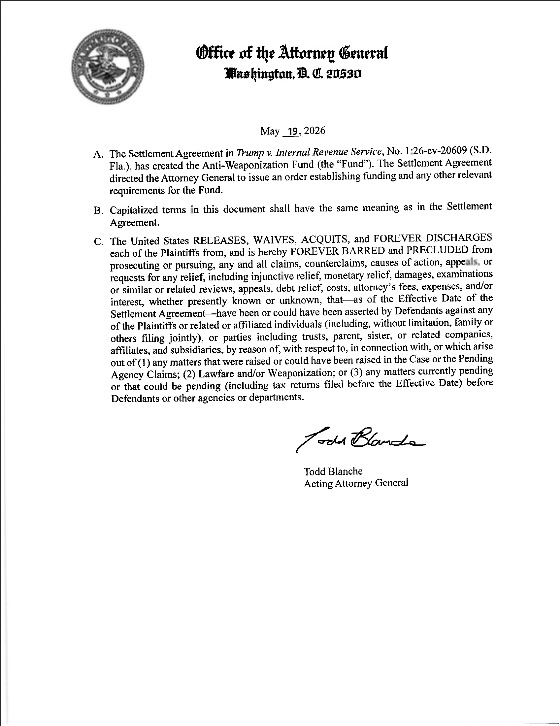 May 19 AG Order
2026
"The parties used the proceedings before this Court as a legal pretext while trying to deprive this Court of the opportunity to determine whether this was a real case or controversy."
— 35 Former Federal Judges · Amicus Motion2026
"A party's decision to file a frivolous lawsuit for the sole purpose of forcing a settlement may qualify as the kind of impropriety that allows a court to investigate whether an attorney has abused the judicial process."
— Judge Kathleen M. Williams · Order, May 29, 20262026
2026
Trump’s lawyers file their court-ordered response, arguing the fraud inquiry rests on a legal impossibility. Rule 41(a)(1)(A)(i) is self-executing: the court was “stripped of jurisdiction” the instant the dismissal notice was filed. That left no adjudicative function that could have been corrupted — and no foothold for the ex-judges, who were never parties to the case, to intervene.
The filing warns that further judicial intrusion into the Executive Branch’s independent settlement authority would “warrant extraordinary relief.”
"The fact that Movants are former federal judges only makes their frivolous motion all the more damaging to our rule of law."
— Trump Plaintiffs' Response · June 12, 20262026
2026
2026
“That one ‘side’ of the purported dispute could unilaterally scrap a material term without even so much as a revised written agreement makes it crystal clear that these parties were never adverse.”
— 35 Former Federal Judges · Reply Brief · June 19, 20262026
"In our many years of federal tax experience... this is decidedly not 'how government settlements work.'"
— Former IRS & DOJ Officials · Amicus Brief · June 22, 2026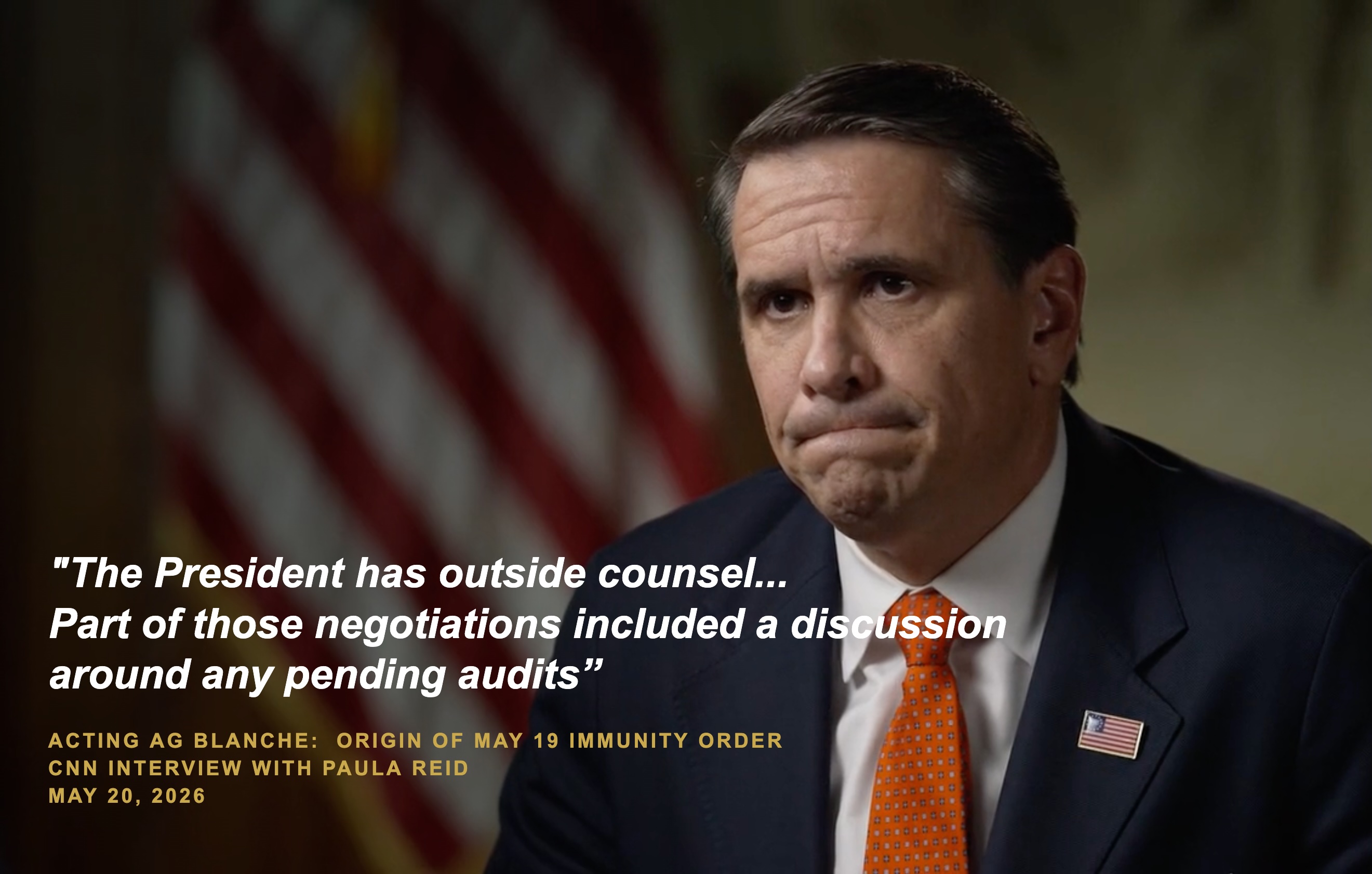
2026
2026
Judge Williams issues a paperless order denying three requests to submit amicus briefs: including the June 15, June 22, and June 23 briefs.
“The Court greatly appreciates the assistance that these attorneys have offered through their proposed filings. However, the Court has determined that this case has been sufficiently briefed and there is no need for additional amici briefing.”
—Judge Kathleen M. Williams · June 25, 2026The denial is procedural, not a signal on the merits. Courts routinely deny late submissions to manage the schedule.
What remains before the court on the motion to reopen: the 35 retired judges' brief (May 27), Trump's opposition (June 12), and the judges' reply (June 19). A ruling on whether to reopen the case and investigate fraud-on-the-court allegations is pending with no governing deadline.
2026
“In sum, the facts before this Court demonstrate there was never adverseness between the Parties; there was never a case or controversy; and there was never a question as to who would prevail.”
— Judge Kathleen M. Williams · Order, July 13, 2026- Brito referred to the Florida Bar.
- Epstein barred from practicing in S.D. Fla. for one year.
- Order transmitted to the New York and D.C. bars, where Blanche and Woodward face ethics complaints.
- Monetary sanctions found warranted: fee petitions due within 14 days. Court-appointed amici declined reimbursement.
- The settlement agreement may never be cited in any official proceeding.
In a footnote, Williams's explicitly declines to void the private settlement agreement, stating "whether a private agreement is valid and enforceable is not before this court." Rule 60(d)(3) fraud-on-the-court relief remains available with no time limit.
2026
The citizen's filing notes the lack of accountability in this system — where complaints against the AG are reviewed by the AG's own office — and hopes that Judge Williams' July 13 order, transmitted to the bar, will succeed where her own complaint did not.
2026
Christopher G. Oprison and Tal Aburos of DLA Piper — one of the world's largest law firms — enter appearances. Each notice states they represent the four Trump plaintiffs "as well as for Attorneys Alejandro Brito, Esq. and Daniel Epstein, Esq." who were sanctioned on July 13.
2026
In response to Judge Williams' July 13 order allowing fee reimbursement requests, the amici respond as follows:
- The court-appointed amici (Gleeson, Verrilli, Gay, Selendy, O'Neil, and Stoughton) decline all reimbursement.
- The initial amici request $39,000. The group includes former IRS Commissioner John Koskinen, former DOJ Tax Division head Kathryn Keneally, former National Taxpayer Advocate Nina Olson, former Tax Division appellate chief Gilbert Rothenberg, Common Cause, and POGO. The request covers 78 hours at $500/hour billed by Democracy Forward Foundation attorneys — for their February 5 brief only. They seek nothing for their second brief, nothing for local counsel, and nothing for clerical work. The memorandum is verified under penalty of perjury.
- The 35 former federal judges ask for $4,610.83 — and decline the rest. They state their actual fees would "substantially exceed $100,000," then request only a nominal $1 per firm (four firms) plus out-of-pocket costs: $4,500 in pro hac vice admission fees for eighteen attorneys, and $106.83 in certified mail. They call it symbolic, and note the court may impose other sanctions if it sees fit.
“[T]here must be accountability for violating the integrity of the court process.”
— Memorandum of Thirty-Five Former Federal JudgesTrump's response would be due within seven days. The July 31 stay motion asks the court to pause these proceedings entirely.
2026
Trump, his two sons, The Trump Organization, and both sanctioned attorneys (Alejandro Brito and Daniel Epstein) file two documents on the same day: a three-page Joint Notice of Appeal to the Eleventh Circuit, and a 24-page expedited motion asking Judge Williams to stay her own July 13 sanctions order pending that appeal. Both are signed by Christopher G. Oprison of DLA Piper.
The motion is largely a required procedural step before the appeals court will hear the request. The filing sets its own deadline: if Judge Williams does not rule by August 5, plaintiffs say they will go directly to the Eleventh Circuit.
The motion details what plaintiffs might argue on appeal:
- Article III adversity. That a President suing in his personal capacity is legally distinct from the office he holds, and that supervising an agency doesn't make him incapable of suing it.
- Punishing a losing argument. That the judge called the question "unprecedented," appointed six amici, and spent thirty pages resolving it — then sanctioned lawyers for taking the losing side.
- Insufficient notice. That neither Brito nor Epstein was ever ordered to show cause, as Rule 11 requires before a court can sanction someone on its own initiative.
- Improper use of news reports. That the court relied on press accounts to find motive and intent, which the Federal Rules of Evidence do not permit.
- No individualized findings. That sanctions were imposed collectively, without determining what any specific plaintiff or lawyer knew or did.
- Prior restraint. That barring reference to the settlement agreement unconstitutionally restricts speech and the right to petition courts and agencies.
- Overbreadth. That the order binds affiliates and anyone "acting in concert" — people never accused of anything and never heard from.
- No fees for amici. That non-parties cannot recover attorney's fees as prevailing parties.
- No jurisdiction over the settlement. That a court which says an agreement's validity is "not before" it cannot regulate how that agreement is used elsewhere.
The Motion states that plaintiffs' counsel conferred with counsel for the Defendants (the IRS and Treasury) who "do not oppose" the stay. Six months into this case, no attorney has appeared for the Defendants.
2026
Judge Williams issues a paperless order for the six court-appointed amici to address "the multiple issues raised in Plaintiffs' and their attorneys' (July 31) Motion" and identify relevant legal authority.
2026
No adverseness — Article III problem
The President controlled both sides of the lawsuit. The court itself flagged this before the parties sidestepped the inquiry by settling.
Statute of limitations — time-barred
The primary §7431 claim carries a two-year limit. The Littlejohn leak became publicly known more than two years before the complaint was filed. DOJ never raised this defense.
Wrong defendant — contractor ≠ federal employee
§7431(a)(1) waives sovereign immunity only for disclosures by federal officers or employees — not contractors. DOJ had successfully argued this very point in Safe Harbor v. IRS and Griffin v. IRS while simultaneously refusing to raise it here.
Damages untethered from law
The $10 billion demand had no legal basis — §7431 caps damages at $1,000 per unauthorized disclosure or actual/punitive damages. DOJ never contested the amount.
IRS audit immunity — unauthorized and potentially criminal
The May 19 Immunity Order purports to bar the IRS from auditing Trump, his family, and affiliated businesses for any matter arising before May 18, 2026. Former senior DOJ and IRS officials argue this violates 26 U.S.C. § 7217, which prohibits the President from directly or indirectly requesting termination of any taxpayer's audit.
No DOJ referral — AG lacked authority over tax liability
The Attorney General's authority to settle tax cases under 26 U.S.C. § 7122 is limited to cases formally referred to DOJ by the IRS. Trump v. IRS was a disclosure lawsuit where underlying tax liabilities were never at issue and never referred.
Domestic Emoluments Clause
Article II, §1, cl. 7 bars the President from receiving any emolument from the United States beyond fixed compensation. Courts have defined "emolument" broadly to include any profit, gain, or advantage. The Immunity Order would shield the President from a reported $100+ million IRS audit exposure, plus unknown other liabilities — constituting exactly such a benefit.
"I'm supposed to work out a settlement with myself."
— President Donald Trump · Said to reporters, ~Jan. 31, 2026Who's suing: CREW, a nonpartisan government watchdog organization.
Core argument: DOJ failed to respond to CREW's November 2025 FOIA request for records on Trump's two $230 million FTCA administrative claims: the Mar-a-Lago and Russia investigation claims that were incorporated into the May 18 settlement. The public has never seen the claim documents, any government assessment of their merits, or any ethics review of Blanche's and Woodward's involvement.
Why it matters: The FTCA claims are explicitly described in the settlement agreement as claims being withdrawn by Trump. This is the only legal action targeting those underlying $230M claims directly. The claims were filed secretly, never made public before October 2025, never litigated, and resolved without a single defense raised by the government.
2025
2026
June
2026
Who's suing: Safe Harbor International LLC, as lead plaintiff in a putative class action on behalf of 400,000+ taxpayers whose confidential return data was disclosed by IRS contractor Charles Littlejohn — the same underlying act as in Trump v. IRS. Filed in the U.S. District Court for the District of Maryland.
Core argument: Plaintiffs sue under the same statute (26 U.S.C. §7431) and for the same Littlejohn disclosures as Trump v. IRS. Unlike in Trump's case, DOJ vigorously argued that because Littlejohn was a contractor (not a federal employee), the government is not liable for damages. The court denied a motion to dismiss on April 2, 2026, and the class action proceeds.
Why it matters: The contrast is central to critics' arguments about self-dealing: 400,000+ ordinary taxpayers face the government's full contractor-immunity defense in this court, while Trump — who controlled both sides of his own case — faced no defense at all and secured a $1.776 billion fund. Note: This case does not directly challenge the Anti-Weaponization Fund; it is included as context for the DOJ's selective legal strategy.
2025
2026
Who's involved: The United States, as prosecutor, against Charles Edward Littlejohn, a contractor for Booz Allen Hamilton assigned to work on the firm's IRS contracts. Filed in the U.S. District Court for the District of Columbia.
Core facts: Littlejohn took a contracting position at the IRS specifically to access and leak confidential tax return data. He disclosed President Trump's tax returns to one news organization in 2019–20, then separately stole and disclosed the tax return information of thousands of the nation's wealthiest taxpayers to a second news organization in 2020. He pleaded guilty to a single count of unauthorized disclosure of tax return information and was sentenced by Judge Ana C. Reyes to the statutory maximum: 60 months in prison, 36 months of supervised release, a $5,000 fine, and a $100 special assessment. He has since appealed his sentence.
Why it matters: This criminal case is the factual origin point for every other case on this tracker. The Information and plea papers establish, on the record, that Littlejohn was a contractor — not a federal officer or employee. That distinction became the central legal battleground in the civil suits that followed: DOJ used it to seek dismissal in Griffin v. IRS and Safe Harbor v. IRS, but never raised it in Trump v. IRS, despite the underlying conduct, statute, and defendant being identical.
2020
2023
2024
2024
2024
2025
Who's suing: Kenneth C. Griffin, founder and CEO of Citadel and one of the taxpayers whose confidential return information was disclosed by IRS contractor Charles Littlejohn — the same underlying conduct at issue in Trump v. IRS. Filed in the U.S. District Court for the Southern District of Florida, the same court that later heard Trump's case.
Core argument: Griffin sued in December 2022 — nearly a year before Littlejohn was even identified — alleging the IRS's known security failures let someone leak his tax data to ProPublica. The government's first motion to dismiss argued the claim was pure speculation about an unidentified leaker. After Littlejohn was criminally charged, Griffin amended his complaint, and the government's second motion to dismiss pivoted to a new defense: Littlejohn was a contractor, not a federal employee, so sovereign immunity barred a §7431 claim against the United States. In April 2024, the court denied that jurisdictional challenge as to Griffin's primary theory, while ordering him to show cause on his alternate theories and dismissing the Privacy Act count for lack of pleaded damages.
How it ended: Griffin withdrew his suit on June 24, 2024. The next day, the IRS issued a public statement (IR-2024-172) apologizing to Griffin "and the thousands of other Americans whose personal information was leaked," acknowledging it "failed to prevent Mr. Littlejohn's criminal conduct."
Why it matters: Trump's lawyers later cited this court's April 2024 order as proof their own lawsuit "had independent merit," telling Judge Williams that the same court had already held "substantially identical allegations" sufficient to state a claim under §6103. Yet DOJ never raised the contractor-defense argument it used against Griffin when it came to Trump's case — the same defense that, in Littlejohn's own deposition testimony here, he confirmed by stating he was "never" an employee of the IRS or the United States.
2022
2023
2023
2024
What to watch.
Upcoming dates and decision points. Filter by Court, Congress, or All.
Courts, not this site, will determine the outcome. All legal claims are presented as active proceedings. Source citations link to primary documents — court filings and official orders — wherever available.
On the record.
Quotes from judges, litigants, and policymakers — on the record.
"The Sanctions Order thus punished Movants for losing a legal argument the Court itself needed dozens of pages to resolve."
"[Plaintiffs] pursued this lawsuit in bad faith for the improper purpose of dishonestly advancing a political narrative."
"[T]his was an attempt to use the Court to provide some legitimacy to an agreement to confer immunity to people and entities affiliated with the President and to earmark billions of dollars from American taxpayers to redress grievances not defined in the law."
"In sum, the facts before this Court demonstrate there was never adverseness between the Parties; there was never a case or controversy; and there was never a question as to who would prevail."
"That the defendants have refused to accord a genuine degree of trustworthiness to their representations about the Fund not going forward is particularly concerning because of the President's consistent support for the Fund and Acting Attorney General Blanche's acknowledgement that the Fund remains 'important.'"
"I give the Justice Department this warning: Don't play possum with me."
"I'm not committing to putting anything in writing."
"It is unclear to this Court whether the Parties are sufficiently adverse to each other so as to satisfy Article III's case or controversy requirement."
"The parties' conduct makes clear that they manufactured a lawsuit for the sole purpose of executing a collusive settlement to benefit the Trump family and enrich President Donald Trump's political allies, in an end-run around constitutional limits on executive power."
"We will do everything in our power to make whole those who were persecuted for political purposes."
"A jaw-dropping act of presidential corruption."
"It is unclear to this Court whether the Parties are sufficiently adverse to each other so as to satisfy Article III's case or controversy requirement."
"No funds are irreversibly disbursed from the 'Anti-Weaponization Fund' while there are motions pending to block the distribution of funds."
"We will do everything in our power to make whole those who were persecuted for political purposes."
"A party's decision to file a frivolous lawsuit for the sole purpose of forcing a settlement may qualify" as the kind of impropriety that allows a court to investigate and determine whether an attorney has abused the judicial process.
"A jaw-dropping act of presidential corruption."